What Small Businesses Need to Know About NYC’s Storefront Gate Law
UPDATE 4 p.m. on May 18: Council Member Althea Stevens has introduced a bill in the City Council that would repeal the Local Law 75 requirement. In response, the NYC Department of Buildings has announced today that the agency will hold off enforcing the law while the Council reviews the proposed legislation. The rest of this post includes details about the 2009 law that, as we understand, would still apply if the Council does not pass the proposed bill and DOB decides to resume enforcement. We will provide updates here as well learn more.
For years, a 2009 New York City law sat quietly on the books, largely unknown to the small business owners it was meant to affect. Local Law 75 requires most commercial storefronts to replace solid metal roll-down security gates with gates that are at least 70% transparent. The city gave owners a long runway — enforcement doesn’t begin until July 1, 2026 — on the theory that most gates would naturally wear out and get replaced over 17 years anyway. But, less than two months away, many business owners may still be wondering what changes they’ll need to make.
It’s difficult to find data on how many storefronts have the required gate across the city. In some areas, the compliance rates are as low as 12 to 15 percent. Owners in southern Brooklyn neighborhoods say they are hearing about the law for the first time with less than two months to act. The costs are real: gate replacement can run anywhere from $1,000 to $10,000 or more per gate, at a moment when the New York Fed’s business climate index recently hit its lowest reading since COVID. Some owners have also raised security concerns, worrying that transparent gates make storefronts more vulnerable to smash-and-grab incidents. The Brooklyn Chamber has formally asked elected officials to delay or repeal the law, and some City Council members are reportedly considering legislation to that effect, though no bill has been introduced as of this writing.
Here’s what you need to know.
What is actually required?
Any storefront security gate on a commercial building must allow at least 70% visibility from the sidewalk when closed. Solid or near-solid metal roll-down gates do not comply. In practice, the 70% is measured as the visible open area of the gate when fully closed, as seen from the sidewalk. Open-mesh or open-bar grilles generally meet this standard. Partially perforated metal panels may or may not qualify depending on the perforation percentage and should be verified with a licensed professional before assuming compliance. When purchasing a replacement gate, compliant models will be sold specifically as meeting the 70% open-area requirement. Click here to learn more about the requirements.
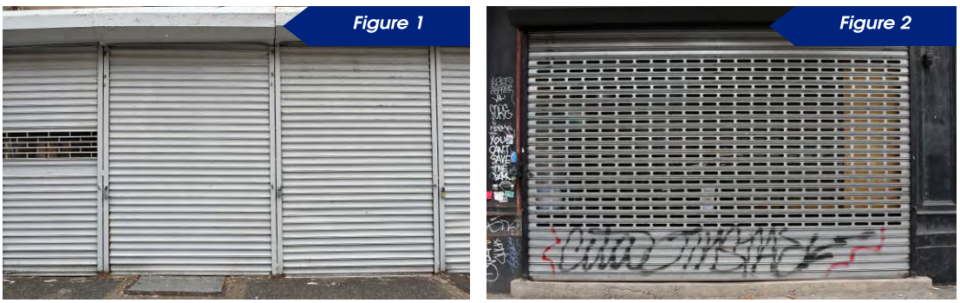
After July 1, security grilles can no longer be solid, like the gate shown in Figure 1. Instead, they have to have at least 70% visibility, like the gate in Figure 2.
Who does this apply to?
The law covers buildings classified as Occupancy Group B (offices, banks, professional services) and Occupancy Group M (retail stores, shops, markets). If you are unsure of your building’s classification, check your Certificate of Occupancy or search your property on the DOB NOW public portal.
Are there any exceptions or defenses available?
If your gate was installed before July 1, 2011, you are not legally required to replace it. The law simply does not apply to gates predating that date. That said, a DOB inspector cannot always tell when a gate was installed just by looking at it, so if you receive a violation, you will need to show documentation proving the installation date: contractor invoices, purchase records, old permits, anything contemporaneous. Keep that paperwork accessible. Separately, buildings in NYC Landmark-designated historic districts are exempt regardless of when the gate was installed. There are no other exceptions or hardship waivers available.
How much will this cost and how do I comply?
Replacement costs vary widely but commonly run $1,000 to $10,000 per gate. To comply, you will need a DOB permit, potentially a licensed design professional to prepare plans, and a licensed contractor to do the installation. Note that permit processing alone can take 4 to 8 weeks. Given how many businesses are now scrambling, contractors may be hard to book. Start the permitting process now through the DOB NOW portal (a810-dobnow.nyc.gov).
What happens if I miss the deadline?
The DOB will begin issuing violations on July 1, 2026. Once you receive a violation, you have 90 days to correct the condition and file a Certificate of Correction with the DOB; no penalty is imposed if you cure it within that window. After 90 days, fines start at $250 for a first offense and $1,000 for each subsequent violation.
My lease says the landlord is responsible for building maintenance. Does that mean they have to pay for this?
Not necessarily. Commercial leases vary widely, and gate compliance responsibilities are typically allocated to the tenant regardless of general maintenance language. If you are uncertain where the obligation falls under your specific lease, that is worth reviewing carefully before you spend money on a replacement.
How BUJNYC Can Help
If you have questions about whether your lease requires you or your landlord to bear the cost of gate replacement, our Community Economic Development (CED) team can review your commercial lease and advise on where the responsibility lies. While we do not handle DOB permitting directly, we can help you understand your legal obligations and your options if a dispute with your landlord arises over compliance costs. Reach out to us at [email protected] or 718-487-2300.
Feature image: Painted steel rolldown gate of East Village hardware store | Photo by Dan Nguyen